Inventory & Order Management System for a Multi-Warehouse Distributor
Replacing spreadsheets and a legacy desktop app with a real-time inventory and order automation platform
A technical case study on building a centralized inventory and order management platform in Go and React for a wholesale distributor — replacing spreadsheets and a legacy desktop app with real-time automation and ERP integration.

Iago Mussel
CEO & Founder
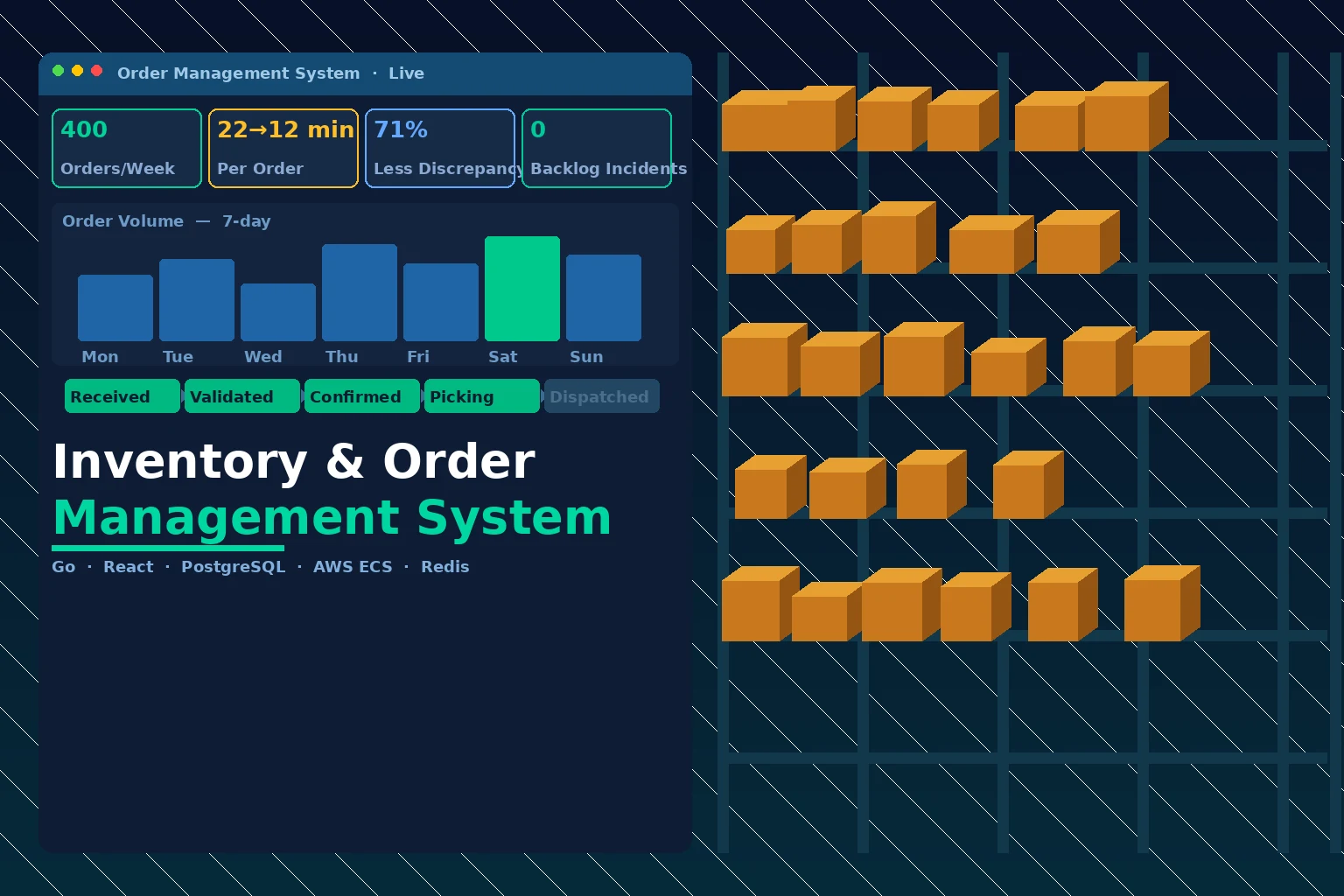
When a wholesale distributor starts losing orders to manual processing errors, the cost is no longer abstract — it shows up in chargebacks, missed shipments, and staff overtime. The existing system was a patchwork of spreadsheets and a legacy desktop application that had not been updated in six years.
HunterMussel was engaged to design and deliver a centralized inventory and order management platform — a system that would replace manual workflows with structured automation, integrate directly with supplier ERP systems, and give warehouse staff and operations managers a single source of truth across three locations.
Project Context
Client: Mid-size wholesale distributor in the industrial supplies sector (identity protected under NDA) Scale: 3 warehouse locations, 18 operations staff, approximately 400 orders processed per week Prior System: Excel-based stock tracking + legacy desktop app with no API access Engagement Duration: Completed in approximately 3 months at 20 hours/week Investment: 340h / $18,700 at $55/h — invoiced at actual hours worked (initial estimate: 500h) Measurement Period: Operational metrics collected across 60 days post-launch
The Challenge: Manual Workflows at Scale Break Predictably
Three structural problems were identified during the discovery phase:
- No Real-Time Inventory Visibility: Stock levels were updated manually at end-of-shift, creating a window where orders could be accepted for items already depleted.
- Order Processing Bottleneck: Each order required manual entry, manual supplier verification, and manual status updates — averaging 22 minutes of staff time per order.
- Zero ERP Integration: Purchase orders to suppliers were sent via email, with no automated reconciliation between what was ordered and what arrived.
As order volume grew, these bottlenecks compounded. Staff overtime increased 40% over 18 months while throughput grew only 12%.
The Solution: Centralized Automation Layer
1. Real-Time Inventory Engine
Stock levels update on every inbound shipment scan, every order confirmation, and every return event. The system maintains a live inventory state across all three warehouse locations simultaneously. Low-stock thresholds trigger automated purchase order drafts for manager review — no manual monitoring required.
2. Automated Order Pipeline
Order intake, validation, supplier lookup, availability confirmation, and status broadcasting are fully automated. Staff interaction is required only for exceptions — damaged goods, partial fulfillment, or customer escalations. The average handling time per order dropped from 22 minutes to 12 minutes.
3. ERP Sync via Supplier REST API
The platform connects directly to the primary supplier’s REST API, eliminating email-based purchase orders. Inbound shipments are matched to open POs automatically. Discrepancies are flagged for review rather than silently absorbed into inventory counts.
System Architecture
Core Stack
- API Layer: Go — high-throughput order and inventory operations, state machine enforcement
- Frontend: React dashboard with real-time stock levels, order pipeline status, and warehouse views per location
- Database: PostgreSQL with indexed order state and multi-location inventory tables
- Queue Layer: Redis for async supplier sync jobs, notification dispatch, and report generation
- Reporting: Server-side PDF invoice and packing slip generation via Go
gofpdf
Order State Machine
Each order moves through a strictly enforced state machine:
Received → Validated → Supplier Confirmed → Picking → Packed → Dispatched → DeliveredEvery state transition triggers automated downstream actions: supplier API calls, inventory deductions, staff notifications, and — on dispatch — PDF invoice generation and customer email delivery.
Infrastructure & Deployment
Cloud Provider: AWS Compute: ECS Fargate for the Go API service and a separate Go sync worker task definition; independent scaling per service Database: Amazon RDS (PostgreSQL Multi-AZ) — primary for writes, read replica for reporting and dashboard queries Cache & Queue: Amazon ElastiCache (Redis) for job dispatching, order event queuing, and session management Object Storage: S3 for generated PDF invoices, packing slips, and audit log archives CDN: CloudFront for React dashboard static assets Networking: VPC with private subnets isolating database and queue tiers from public endpoints; API exposed via Application Load Balancer Secrets: AWS Secrets Manager for supplier API credentials, DB connection strings, and email delivery keys
Deployment Pipeline
- GitHub Actions CI/CD with Go unit tests, state machine integration tests, and
go vetchecks on every push - Docker images tagged per commit and stored in ECR
- ECS rolling deployments with minimum healthy threshold; automatic rollback on health check failure
- Terraform manages all infrastructure resources; staging environment mirrors production topology
Observability & Monitoring
Inventory errors carry financial consequence. A missed stock event or a stuck order is not a UX issue — it is a revenue issue. Monitoring was designed around those failure modes specifically.
Metrics: CloudWatch with custom metrics for order processing latency, supplier sync success rate, and inventory mutation throughput Error Tracking: Sentry capturing Go API panics and React runtime errors with full stack traces Dashboards: Grafana panels for order pipeline throughput, queue depth, supplier API response times, and per-location inventory event rate Alerting: PagerDuty for supplier API failures, queue consumer saturation, and orders stuck in a single state for more than 30 minutes Audit Logging: Every inventory mutation and order state transition is stored with timestamp, user ID, and trigger source (API, worker, or manual override)
Key dashboards tracked:
- Order pipeline throughput (orders/hour)
- Order processing latency p50 and p95
- Supplier API success rate and response latency
- Queue depth and consumer lag per worker group
- Per-location inventory event rate and low-stock alert frequency
Infrastructure Diagram
graph TD
    Staff["Operations Dashboard<br/>(React)"]
    CF["CloudFront CDN"]
    ALB["Application Load Balancer"]
    API["Go API<br/>(ECS Fargate)"]
    Worker["Go Sync Worker<br/>(ECS Fargate)"]
    Redis["ElastiCache Redis<br/>(Queue / Cache)"]
    RDS["RDS PostgreSQL<br/>(Multi-AZ + Read Replica)"]
    S3["S3<br/>(Invoices / Audit Logs)"]
    SupplierAPI["Supplier ERP REST API"]
    CW["CloudWatch + Grafana"]
    Sentry["Sentry"]

    Staff --> CF
    CF --> ALB
    ALB --> API
    API --> Redis
    API --> RDS
    Redis -->|Async Jobs| Worker
    Worker --> SupplierAPI
    Worker --> RDS
    API --> S3
    API --> CW
    Worker --> CW
    API --> Sentry
    Worker --> Sentry
Results After 60 Days in Production
Measured against the 60-day pre-launch baseline:
- 44% Faster Order Processing: Average staff time per order dropped from 22 minutes to 12 minutes — automated validation, supplier confirmation, and state transitions removed every manual step in the standard path.
- 71% Reduction in Stock Discrepancy Rate: Real-time inventory updates eliminated the end-of-shift sync gap that had caused overselling across all three locations.
- 12 Hours/Week Recovered in Warehouse Operations: Staff time previously consumed by manual reorder tracking, email-based PO management, and shipment reconciliation was fully automated.
- Zero Order Backlog Incidents: The 60-day baseline period included 4 backlog events caused by missed supplier confirmations. Post-launch: zero incidents across the same 60-day window.
Is your operations team managing inventory in spreadsheets while the business grows around them?
HunterMussel builds custom operational platforms designed to replace manual workflows with automation that scales.
Related case studies
High-Performance Corporate Website: Building a Free, Infinitely Scalable Platform
A technical breakdown of how a modern corporate website can achieve near-zero hosting costs, extreme performance, and infinite scalability using a static-first architecture.
AI-Powered LMS: Building an Intelligent Learning Platform with Laravel
A technical deep dive into how an AI-enhanced LMS built on Laravel automates personalization, grading, and learning analytics at scale.
Delivery App Route Optimization: Engineering Real-Time Logistics Intelligence
A technical case study on building a delivery platform with real-time route optimization, predictive dispatching, and AI-driven logistics automation.
Ready to achieve similar results?
Let's discuss how we can apply our expertise to your specific business challenges.
Start a Project