How the Tech Lead role changes when AI enters the development process
More leverage per engineer means different problems at the leadership level.

Iago Mussel
CEO & Founder
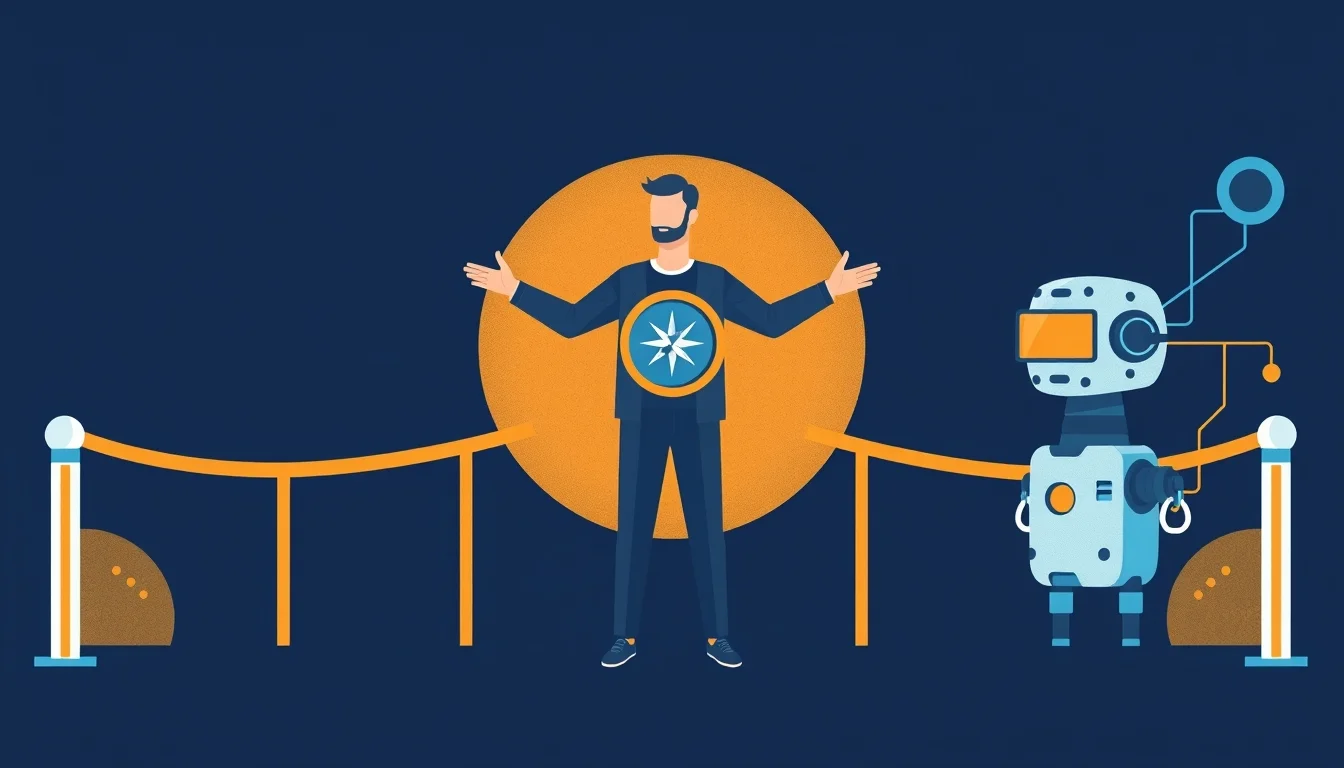
When AI coding tools started shipping in 2022–2023, the conversation was about individual productivity. Engineers shipping faster. Less time on boilerplate.
That conversation has shifted. And if you’re a Tech Lead right now, the interesting question isn’t whether individual engineers are more productive — it’s what that changes at your level.
What actually changed
Output velocity increased. Most teams that adopted AI coding assistants saw a measurable increase in the volume of code being written. PRs came in faster. Features got scaffolded more quickly. Initial implementations appeared in hours instead of days.
Review load increased with it. More code being written means more code being reviewed. A Tech Lead who was already stretched on reviews is now looking at a higher-volume queue. If the team doubled its PR throughput and the review capacity stayed constant, reviews become the bottleneck. I’ve seen this happen. It’s not subtle.
Quality variance increased. AI-generated code is not uniformly good. It’s often syntactically correct, passes tests, and handles the happy path well — and misses edge cases, ignores domain context, or introduces subtle architectural inconsistencies. The variance in code quality has gone up, not down.
Onboarding got harder. New engineers who lean on AI tools to understand the codebase sometimes develop an incomplete model of the system. They can write code that looks like it fits but doesn’t account for the decisions that shaped the architecture. The Tech Lead’s role in ensuring new engineers build deep understanding has become more important, not less.
Where the leverage shifts
Before AI tools, Tech Lead leverage came from being the best engineer in the room — the person who could implement the hardest things and who others learned from by working alongside.
With AI tools amplifying individual engineer throughput, the leverage of raw technical skill narrows. The multiplier is larger when AI can generate the implementation from a well-specified design.
What becomes higher leverage:
Design and specification quality. AI tools implement what they’re asked to implement. The quality of the output depends on the quality of the input — the spec, the context, the constraint documentation. A Tech Lead who can write clear, well-specified designs enables much better AI-assisted implementation than a vague ticket produces. This is now one of your highest-leverage activities.
Architectural coherence. When engineers are moving faster and generating more code, the risk of architectural drift increases. Components that don’t fit together. Patterns that diverge from the codebase conventions. Duplicate implementations of the same functionality. Maintaining coherence across a higher-velocity team is a more demanding coordination problem than it used to be.
Code review as a teaching tool. Reviews need to catch what AI misses: business logic errors, domain context violations, edge cases that weren’t in the prompt. Your reviews become more valuable as a feedback loop — not just catching bugs, but teaching engineers to prompt better, review more critically, and understand where AI assistance needs more human oversight.
Building understanding, not just output. The engineers who stay shallow because AI lets them avoid deep engagement with the system are building a liability. A Tech Lead who prioritizes depth of understanding — asking “why does this work?” even when it does — builds a team that’s resilient when AI fails or when problems require judgment AI can’t provide.
The new failure modes
Shipping fast and wrong. A team with AI tools and a weak review process can ship a lot of plausible-looking code that doesn’t behave correctly under edge conditions. The danger is that the code looks right, tests pass, and the failure only surfaces in production under conditions the tests didn’t cover.
Context collapse. Engineers who rely on AI to understand the codebase — asking “what does this function do?” instead of reading it — may miss the institutional knowledge embedded in the code. When that knowledge matters for a high-stakes decision, the gap shows.
Prompt-shaped code. Code written to satisfy an AI prompt sometimes has the shape of the prompt rather than the shape of the problem. Functions named and organized around how someone described the task rather than how the domain is structured. This is subtle and accumulates over time into a codebase that’s hard to reason about.
Speed over judgment. The faster a team ships, the more valuable judgment becomes. Teams that optimize for throughput without maintaining judgment quality create acceleration in the wrong direction.
What the role looks like now
The Tech Lead who thrives in an AI-augmented team writes better designs and specs, because that’s the highest-leverage input into AI-assisted implementation. Reviews for correctness, coherence, and depth — not just for style. Actively monitors for architectural drift and addresses it before it calcifies. Creates the conditions for engineers to develop real understanding, not just AI-assisted output. And is honest about where AI should and shouldn’t be trusted in the development process.
The role didn’t get smaller. The problems moved upstream.
I work with teams building production systems and developer tooling. If this topic resonates, you can find more of my work at https://huntermussel.com.
Share
 LinkedIn
 Twitter
 Facebook
 WhatsApp
 Telegram
 Reddit
Related articles
GPT-5.6 Sol, Terra, and Luna: You Don't Need All Three
OpenAI's GPT-5.6 family gives you three models with the same huge context window and very different economics. Here's how to pick Sol, Terra, or Luna without turning model choice into a tax on every feature.
Should Your Team Actually Use Claude Fable 5?
The demos are real: one-shot game clones, overnight backlog clears, a two-month migration done in a day. None of that tells you whether Fable 5 belongs in your team's actual workflow. Here's a decision framework.
Claude Fable 5 Will Quietly Downgrade Itself on These Topics
If your work touches biology, cybersecurity, or model training, Claude Fable 5 may silently hand your request to a weaker model, or throttle its own answer without telling you. Here's what that means for real projects.