DevOps for AI teams: the infrastructure nobody teaches
Models are the headline. Infrastructure is the reason most projects die.

Iago Mussel
CEO & Founder
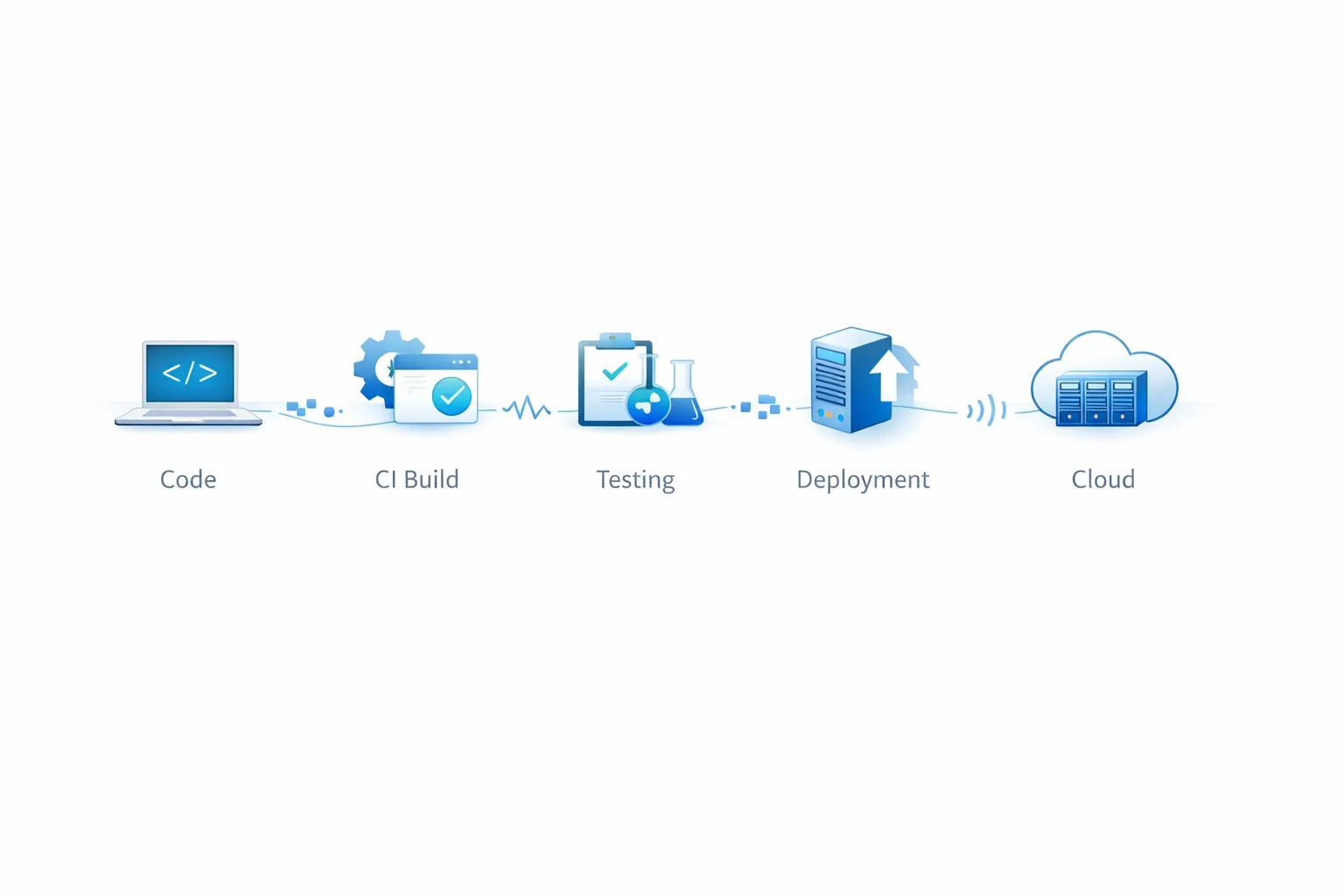
Most AI projects don’t fail because the model is bad. They fail because the team treated the model like a feature and forgot to rebuild the infrastructure around it.
I’ve seen this pattern repeatedly: a team gets a prototype working in a notebook, the demo impresses leadership, and then the handoff to production turns into a six-month slog of cost overruns, flaky inference, and angry platform engineers. The model itself was fine. The surroundings weren’t.
The gap isn’t a skills problem. It’s a framing problem. AI workloads are not deterministic services. They burst, they cost unpredictably, they need specialized observability, and they turn your data pipeline into a production dependency. DevOps for AI teams means redesigning the platform layer for that reality.
Inference is not a web request
A standard API call returns in milliseconds and costs roughly the same every time. An LLM call returns in seconds, consumes tokens that vary wildly with input, and can fail in ways that look like success. Partial hallucinations, context-window overflows, and vendor-side rate limits all return HTTP 200. Your usual HTTP health checks won’t catch them.
This changes how you design retries, timeouts, and fallbacks. You need token budgets per request, per user, and per hour. You need circuit breakers that trip on cost or latency, not just on 5xx errors. And you need a way to route traffic between models — maybe the cheap one handles 80% of queries and the expensive one handles the edge cases — without hard-coding that logic into every consumer.
The infrastructure team that treats inference like a normal microservice ends up with surprise bills and unpredictable user experience. The team that builds an inference gateway — with routing, retries, budgets, and observability — can iterate on models without breaking the product.
CI/CD for models and prompts
Your application code changes daily. Your model or prompt might change hourly in early experiments. If you deploy them together, you lose the ability to roll back one without the other. Worse, you can’t measure whether a regression came from code, model weights, or a prompt edit.
The fix is versioning everything. Models, prompts, embeddings, evaluation datasets, and configuration all go into version control or a model registry. Deployments become reproducible. A/B tests become possible. Rollbacks take minutes instead of days.
We usually structure it like this:
- Application code deploys through the normal CI/CD pipeline.
- Prompt changes deploy as configuration updates, gated by automated evaluation.
- Model upgrades deploy through a separate promotion path: dev eval → staging eval → shadow production → partial traffic → full rollout.
That separation is what lets you move fast without shipping broken reasoning to users.
Data pipelines become production dependencies
In a traditional app, a data pipeline might feed analytics or reporting. In an AI product, it feeds the product itself. Retrieval-Augmented Generation systems pull from vector stores that are only as good as the ingestion pipeline that built them. If that pipeline breaks silently, answers get stale or wrong — and users notice before your dashboards do.
This means data pipelines need the same operational rigor as your API. They need monitoring, alerting, idempotency, schema contracts, and tests that fail the build when document quality drops. The team that owns the AI feature also needs visibility into what the retrieval system actually returned, not just what the model said.
Cost controls are part of reliability
LLM costs don’t scale linearly. They scale with token count, context length, retry storms, and accidental infinite loops from agents. The first production incident I see in most AI teams is a budget incident, not a correctness incident.
Basic controls you need before going live:
- Per-user and per-session token caps.
- Input/output token logging attached to your tracing.
- Alerts on cost per request and cost per user.
- Circuit breakers that fall back to cheaper models or cached responses.
- A kill switch for agentic workflows that can loop.
These aren’t finance controls. They’re reliability controls. An unbounded spend spike is just another form of outage.
Observability has different questions
Traditional observability asks: is the service up and is latency acceptable? AI observability also asks: is the output correct, is it safe, and is it getting worse over time?
You need traces that include the full prompt, the retrieved context, the model response, and any tool calls. You need evaluation scores that run automatically against a representative dataset. And you need a way to compare production outputs across model versions without manually reading hundreds of responses.
If you can’t answer “is this model getting worse?” in under ten minutes, you don’t have observability yet. You have logs.
The platform skills gap
The hardest part of this transition is rarely the tooling. It’s that most platform teams were trained to manage stateless, deterministic services, and AI workloads break those assumptions. The same engineer who can build a rock-solid Kubernetes platform may struggle with prompt versioning or evaluation-driven deployment.
Bridging that gap means either upskilling the platform team or bringing in people who have shipped AI systems before. In practice, it takes both. The platform team owns reliability, scale, and cost. The AI team owns evaluation, prompts, and data. The boundary between them needs to be explicit, or every incident becomes a blame game.
What to do this week
If you’re running an AI team today, start with three things:
- Separate model and code deployments. Even if it’s just separate branches or artifacts, get that split in place.
- Add token and cost limits to your inference layer. Pick caps that would hurt if exceeded, then monitor against them.
- Build one automated evaluation that runs on every model or prompt change. Manual spot checks don’t scale.
None of these require a new vendor or a platform rewrite. They require treating AI infrastructure as infrastructure, not as an experiment that somehow ended up in production.
If your team is moving from prototype to production and the infrastructure picture is still fuzzy, our DevOps and AI infrastructure work is built around exactly that transition.
Share
 LinkedIn
 Twitter
 Facebook
 WhatsApp
 Telegram
 Reddit
Related articles
Agentic DevOps in 2026: what actually changes for engineering teams
What Agentic DevOps really looks like in production pipelines, where AI agents help, where they break, and the guardrails you need before enabling them.
How a modern CI/CD pipeline works — and where AI actually fits
A clear breakdown of modern CI/CD pipelines, what each stage does, and where AI is genuinely useful versus just hype.
The problem with migrating from Jenkins to GitHub Actions in the middle of critical systems
Migrating CI/CD for systems that can't afford downtime or broken deploys requires more than rewriting Jenkinsfiles. Here's the strategy that works.