Smart CRM with AI Lead Scoring: Building a Predictive Sales Intelligence Platform
Turning raw leads into ranked revenue opportunities through predictive intelligence
A technical case study on designing a CRM with AI-powered lead scoring, predictive conversion analytics, and automated sales prioritization.

Iago Mussel
CEO & Founder
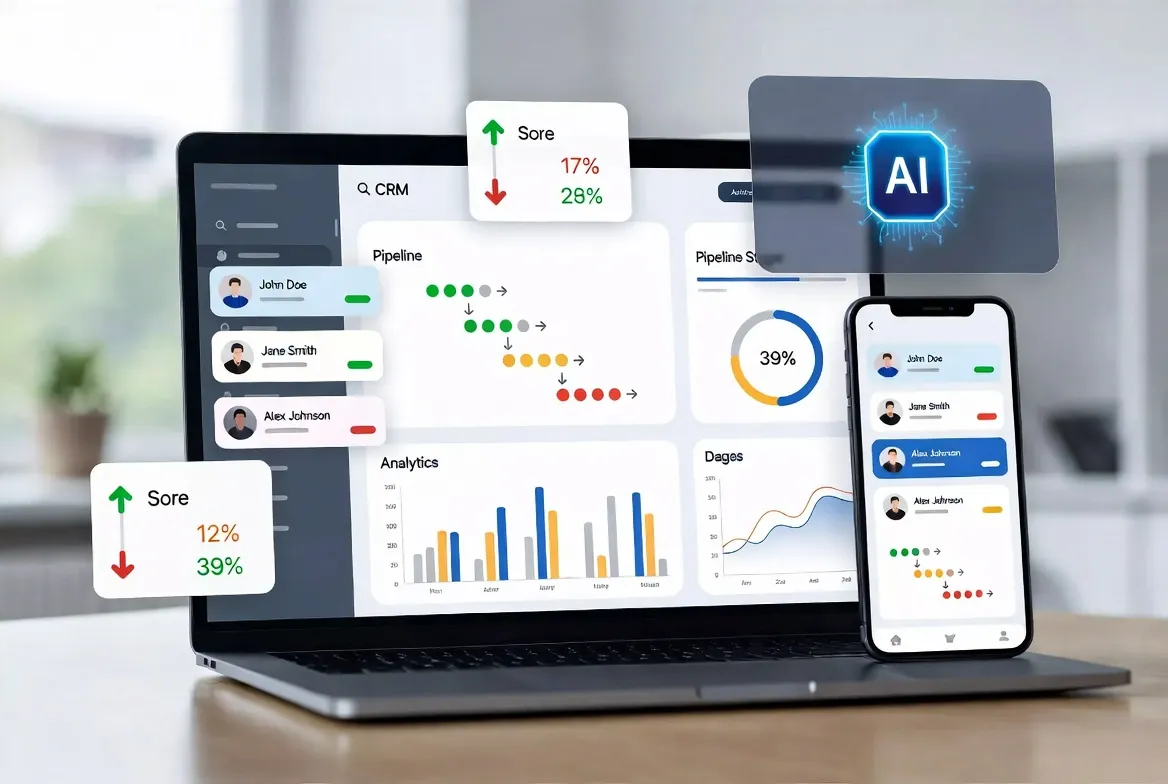
Most CRM systems store data. Few actually interpret it. Sales teams often rely on intuition to decide which leads to pursue, resulting in missed opportunities and wasted effort.
In this project, HunterMussel developed a smart CRM platform with AI-driven lead scoring designed to transform raw contact data into ranked, actionable insights. The objective was to eliminate guesswork from sales pipelines and replace it with predictive decision logic.
Project Context
Client: B2B SaaS company serving the HR and workforce management sector (identity protected under NDA) Scale: 14-person inside sales team managing approximately 1,600 active leads per quarter Engagement Duration: 4 months from system design to production rollout Measurement Period: Results tracked across two full sales quarters post-deployment, compared to the prior two-quarter baseline
Development Investment
| Total Estimated Hours | ~360 h |
| Rate | $55 / hour |
| Total Investment | ~$19,800 |
| Timeline at 20 h/week | ~18 weeks (4.5 months) |
| Timeline at 40 h/week | ~9 weeks (2.25 months) |
Phase breakdown:
| Phase | Hours |
|---|---|
| Discovery, CRM data modeling & scoring architecture | 30 h |
| Laravel backend, API & lead pipeline logic | 100 h |
| Python ML scoring service & model training pipeline | 90 h |
| React sales dashboard & real-time lead ranking UI | 60 h |
| AWS infrastructure (Terraform, ECS Fargate, RDS Multi-AZ) | 40 h |
| CI/CD pipeline & rolling deployment configuration | 20 h |
| Observability, model drift monitoring & alerting | 20 h |
| Total | 360 h |
Estimates assume a single developer. A two-person team (backend + ML/frontend split) can deliver in roughly half the calendar time at the same total cost.
The Bottleneck: Manual Prioritization Does Not Scale
During system analysis, three recurring limitations appeared in traditional CRM workflows:
- Flat Lead Lists: All leads are treated equally, regardless of probability to convert.
- Delayed Insights: Sales teams discover lead quality only after investing time.
- Inconsistent Qualification: Different team members evaluate leads using subjective criteria.
As lead volume increases, these inefficiencies compound, causing reduced conversion rates and slower revenue cycles.
The Solution: Predictive Lead Intelligence Engine
Instead of adding scoring rules manually, we implemented a machine-learning pipeline capable of evaluating leads continuously based on behavioral and historical data.
1. Behavioral Signal Analysis
The system tracks interaction signals such as:
- Page visits
- Email engagement
- Time between actions
- Feature interest patterns
Each signal contributes to a dynamic probability score representing conversion likelihood.
2. Adaptive Scoring Model
A classification model trained on historical CRM data identifies patterns shared by leads that previously converted. The system automatically adjusts weights as new data enters the pipeline, ensuring predictions remain accurate over time.
3. Automated Sales Prioritization
Leads are ranked in real time. The CRM dashboard surfaces:
- Highest conversion probability
- Leads at risk of churn
- Opportunities requiring immediate follow-up
This allows sales teams to focus effort where impact is highest.
System Architecture
The platform was designed with modular AI services layered on top of a robust CRM core.
Core Stack
- Backend: Laravel service architecture
- AI Engine: Python models exposed via internal APIs
- Database: PostgreSQL with event-driven lead activity tables
- Queue Layer: Redis for asynchronous scoring updates
- Frontend: Reactive dashboard for live lead ranking
Scoring Pipeline Each lead passes through a prediction workflow:
- Event ingestion
- Feature extraction
- Model inference
- Probability scoring
- Priority classification
- Dashboard update
This architecture allows scoring to occur instantly without slowing user interactions.
Infrastructure & Deployment
The platform was deployed on AWS using a containerized architecture to ensure environment consistency and horizontal scalability.
Cloud Provider: AWS Compute: ECS Fargate for the Laravel API and Python scoring service Database: Amazon RDS (PostgreSQL Multi-AZ) for lead and activity data Cache & Queue: Amazon ElastiCache (Redis) for async job processing Object Storage: S3 for model artifacts and lead attachments CDN: CloudFront for static frontend assets Secrets: AWS Secrets Manager for API keys and model credentials
Deployment Pipeline
- CI/CD via GitHub Actions with automated tests on each push
- Docker images built and pushed to ECR
- ECS rolling deployments with health checks and automatic rollback
- Infrastructure as Code using Terraform modules per service
Observability & Monitoring
Reliable lead scoring requires knowing when predictions degrade or services fail before sales teams are impacted.
Metrics: Amazon CloudWatch for service-level metrics (CPU, memory, queue depth) Application Monitoring: Sentry for error tracking across Laravel and Python services Dashboards: Grafana connected to CloudWatch and custom RDS metrics Log Aggregation: CloudWatch Logs with structured JSON logging per service Alerting: PagerDuty integration for critical alerts (scoring pipeline failures, queue saturation) Model Drift Detection: Weekly batch job comparing recent prediction accuracy against baseline thresholds
Key dashboards tracked:
- Scoring pipeline throughput (events/sec)
- Model inference latency (p50, p95, p99)
- Queue depth and consumer lag
- Lead conversion prediction accuracy over time
Infrastructure Diagram
graph TD
    Browser["Sales Dashboard<br/>(React SPA)"]
    CF["CloudFront CDN"]
    ALB["Application Load Balancer"]
    API["Laravel API<br/>(ECS Fargate)"]
    ML["Python Scoring Service<br/>(ECS Fargate)"]
    Redis["ElastiCache Redis<br/>(Queue / Cache)"]
    RDS["RDS PostgreSQL<br/>(Multi-AZ)"]
    S3["S3<br/>(Model Artifacts)"]
    CW["CloudWatch<br/>+ Grafana"]
    Sentry["Sentry"]

    Browser --> CF
    CF --> ALB
    ALB --> API
    API --> Redis
    API --> RDS
    Redis -->|Async Jobs| ML
    ML --> RDS
    ML --> S3
    API --> CW
    ML --> CW
    API --> Sentry
    ML --> Sentry
Measurable Business Impact
After production deployment, sales performance data from two full quarters showed clear improvements over the prior baseline:
- 52% Increase in Conversion Efficiency: Lead-to-opportunity conversion rate rose from 11% to 16.7%, with high-scoring leads converting at 31%.
- 26% Shorter Sales Cycles: Average time-to-close dropped from 41 days to 30 days, driven by prioritized follow-up on warm leads.
- Forecast Accuracy Improved by 38%: Monthly revenue forecast variance narrowed from ±24% to ±15%, enabling more reliable pipeline planning.
- 2.3× More Qualified Opportunities Per Rep: Each sales rep handled 2.3× more sales-ready leads per sprint without increasing headcount.
Why AI Lead Scoring Changes CRM Strategy
Lead evaluation is fundamentally a pattern-recognition problem. Humans can analyze a few variables at once; machine-learning systems can evaluate hundreds simultaneously.
An AI scoring engine enables:
- Continuous recalibration
- Objective prioritization
- Predictive forecasting
- Scalable qualification
Instead of reacting to pipeline outcomes, organizations can influence them.
Conclusion: Sales Optimization Is a Data Problem
Revenue growth is not determined solely by lead quantity. It depends on identifying which opportunities matter most and acting on them at the right time.
By embedding predictive intelligence into the CRM core, this platform transformed sales operations into a data-driven system that ranks opportunities, guides decisions, and scales performance without increasing workload.
Is your sales team prioritizing leads or guessing?
HunterMussel builds intelligent CRM platforms that convert data into decisions, automation, and measurable revenue growth.
Related case studies
High-Performance Corporate Website: Building a Free, Infinitely Scalable Platform
A technical breakdown of how a modern corporate website can achieve near-zero hosting costs, extreme performance, and infinite scalability using a static-first architecture.
Delivery App Route Optimization: Engineering Real-Time Logistics Intelligence
A technical case study on building a delivery platform with real-time route optimization, predictive dispatching, and AI-driven logistics automation.
AI-Powered LMS: Building an Intelligent Learning Platform with Laravel
A technical deep dive into how an AI-enhanced LMS built on Laravel automates personalization, grading, and learning analytics at scale.
Ready to achieve similar results?
Let's discuss how we can apply our expertise to your specific business challenges.
Start a Project