Intelligent Scheduling & Resource App for Dental Clinics
Transforming clinic operations through predictive scheduling and automation
A technical case study on building an AI-driven scheduling and resource management system that optimizes appointments, chair utilization, and staff allocation for dental clinics.

Iago Mussel
CEO & Founder
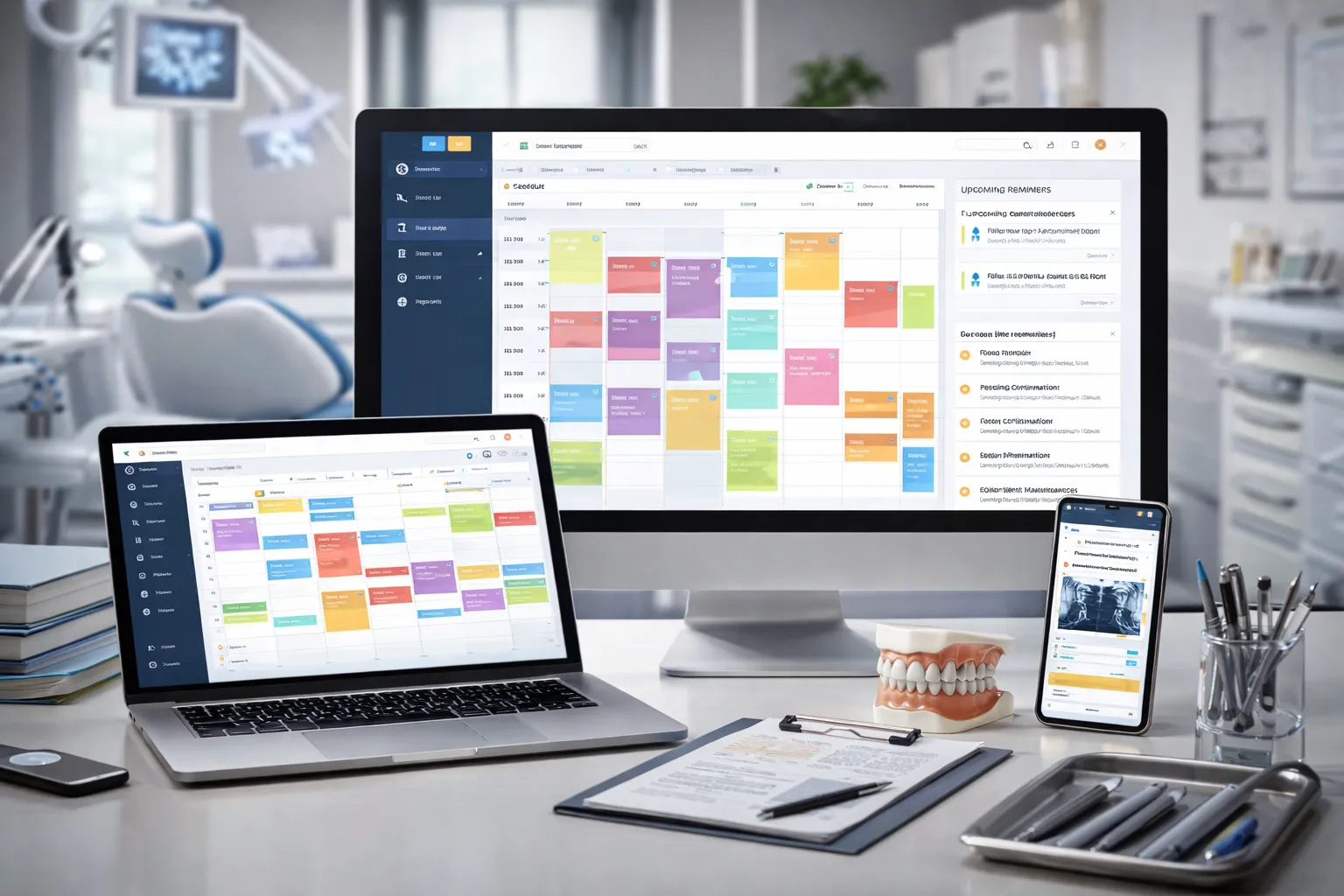
Dental clinics operate on precision timing. Each missed slot, delay, or overbooking affects revenue, patient satisfaction, and staff workload simultaneously. Traditional scheduling systems treat appointments as static entries in a calendar, ignoring the dynamic nature of real-world operations.
In this project, HunterMussel engineered an intelligent scheduling and resource optimization platform tailored for dental clinics. The objective was to convert manual planning into an automated system capable of predicting demand, optimizing chair allocation, and coordinating staff schedules in real time.
Project Context
Client: Multi-location dental group operating 4 clinics across two cities (identity protected under NDA) Scale: 22 dentists, 38 support staff, approximately 380 patient appointments per week across all locations Engagement Duration: 6 months from requirements to full multi-site rollout Measurement Period: Results collected across 60 days of production operation, compared to 60-day pre-deployment baseline
Development Investment
| Total Estimated Hours | ~440 h |
| Rate | $55 / hour |
| Total Investment | ~$24,200 |
| Timeline at 20 h/week | ~22 weeks (5.5 months) |
| Timeline at 40 h/week | ~11 weeks (2.75 months) |
Phase breakdown:
| Phase | Hours |
|---|---|
| Discovery, workflow analysis & constraint modeling | 40 h |
| Laravel API, business logic & multi-tenant architecture | 110 h |
| Python scheduling optimizer & constraint solver | 100 h |
| Clinic staff dashboard (React) | 60 h |
| AWS infrastructure (Terraform, ECS, RDS Multi-AZ, VPC) | 60 h |
| CI/CD pipeline & regression test fixtures | 25 h |
| Observability setup & alerting (CloudWatch, PagerDuty) | 20 h |
| Multi-site deployment, staff onboarding support & UAT | 25 h |
| Total | 440 h |
The multi-clinic rollout phase includes integration support at each location and is the primary driver of this project’s longer calendar duration relative to single-site builds.
The Operational Gap: Static Calendars vs. Dynamic Clinics
An analysis of existing workflows revealed three structural inefficiencies:
- Rigid Appointment Logic: Fixed-duration bookings failed to account for procedure variability.
- Underutilized Resources: Chairs, assistants, and equipment were often idle due to poor allocation logic.
- Reactive Management: Staff adjustments occurred only after delays happened, not before.
As patient volume increased, these inefficiencies scaled into scheduling conflicts, overtime costs, and lost appointment opportunities.
The Solution: Predictive Scheduling Engine
Rather than improving manual scheduling, we replaced it with a decision system designed to optimize clinic operations continuously.
1. Adaptive Appointment Allocation
The system analyzes historical treatment data to estimate realistic procedure durations. Instead of assigning fixed time blocks, it dynamically allocates slots based on:
- Procedure type
- Dentist speed profile
- Patient history
- Equipment requirements
This reduces idle gaps and prevents cascading delays.
2. Resource Coordination Layer
Appointments are treated as multi-resource events. The engine automatically ensures availability of:
- Dental chairs
- Assistants
- Specialized tools
- Rooms
If a constraint conflict occurs, the system proposes optimized alternatives instantly.
3. Predictive Demand Modeling
Using time-series forecasting, the platform anticipates peak booking periods and adjusts availability rules accordingly. Clinics can preemptively extend hours or assign additional staff before demand spikes occur.
System Architecture
The platform was designed to operate with real-time responsiveness and modular extensibility.
Core Stack
- Backend: Laravel API for structured business logic
- Optimization Engine: Python microservices for prediction and scheduling logic
- Database: PostgreSQL with temporal scheduling indexes
- Queue System: Redis for async scheduling calculations
- Frontend: Reactive dashboard for staff coordination
Decision Pipeline Each scheduling action passes through a computation sequence:
- Input validation
- Constraint analysis
- Resource matching
- Conflict simulation
- Optimization scoring
- Final slot assignment
This ensures that every scheduled appointment is mathematically optimal within existing constraints.
Infrastructure & Deployment
The platform was deployed on AWS with a managed container stack designed to meet healthcare-grade reliability requirements without over-engineering a relatively focused workload.
Cloud Provider: AWS Compute: ECS Fargate for the Laravel API and Python scheduling engine; separate task definitions allow independent scaling Database: Amazon RDS (PostgreSQL Multi-AZ) with temporal indexing for appointment windows and resource timelines Cache & Queue: Amazon ElastiCache (Redis) for async scheduling jobs and session caching Object Storage: S3 for historical scheduling reports and model snapshots CDN: CloudFront for clinic dashboard static assets Networking: VPC with private subnets for database and scheduler tiers; API exposed via Application Load Balancer Secrets: AWS Secrets Manager for database credentials and external calendar integration tokens
Deployment Pipeline
- GitHub Actions CI/CD with automated unit tests, constraint solver validation, and database migration checks
- Docker images per service pushed to ECR on merge to main
- ECS rolling deployments with minimum 100% healthy threshold to avoid scheduling downtime
- Terraform manages environment infrastructure; staging environment mirrors production topology
Observability & Monitoring
Scheduling errors have direct patient impact. Monitoring was configured to surface conflicts or optimization degradation immediately, before clinic staff encounter problems.
Metrics: CloudWatch with custom metrics for scheduling decision latency and constraint conflict rate Error Tracking: Sentry capturing exceptions from both Laravel and Python microservices Dashboards: Grafana dashboards showing queue throughput, slot assignment latency, and resource utilization per clinic Log Aggregation: CloudWatch Logs with structured per-request logs; log groups isolated per clinic tenant Alerting: SNS-based alerts for queue saturation, optimization timeout, and failed slot assignments; on-call rotation via PagerDuty Regression Checks: Daily synthetic scheduling job validates constraint solver output against known fixture data; failures trigger immediate alert
Key dashboards tracked:
- Scheduling decision latency (p50, p95)
- Queue depth per clinic
- Daily conflict rate (scheduling overlaps detected and resolved)
- Chair utilization rate across active clinics
- Optimization scoring accuracy over time
Infrastructure Diagram
graph TD
    Staff["Clinic Staff Dashboard"]
    CF["CloudFront CDN"]
    ALB["Application Load Balancer"]
    API["Laravel API<br/>(ECS Fargate)"]
    Sched["Python Scheduling Engine<br/>(ECS Fargate)"]
    Redis["ElastiCache Redis<br/>(Queue / Cache)"]
    RDS["RDS PostgreSQL<br/>(Multi-AZ, Temporal Indexes)"]
    S3["S3<br/>(Reports / Model Snapshots)"]
    CW["CloudWatch<br/>+ Grafana"]
    Sentry["Sentry"]

    Staff --> CF
    CF --> ALB
    ALB --> API
    API --> Redis
    API --> RDS
    Redis -->|Async Scheduling Jobs| Sched
    Sched --> RDS
    Sched --> S3
    API --> CW
    Sched --> CW
    API --> Sentry
    Sched --> Sentry
Measurable Results After Deployment
Within 60 days of production deployment across all four clinic locations, measurable improvements were recorded against the pre-launch baseline:
- 31% Increase in Chair Utilization: Average chair utilization rate rose from 61% to 80% during scheduled clinic hours.
- 42% Fewer Scheduling Conflicts: Automated constraint validation reduced weekly booking conflicts from an average of 34 per clinic to under 20.
- 3.4 Hours Saved Per Clinic Per Day: Reception staff time spent on manual calendar management dropped from approximately 5.1 hours to 1.7 hours per day.
- 19% More Appointments Completed Daily: Average completed appointments per chair per day increased from 6.3 to 7.5 without extending operating hours.
Why Intelligence Matters in Healthcare Scheduling
Healthcare environments contain more variables than typical scheduling systems can handle manually. Each appointment involves time, personnel, equipment, and patient-specific factors.
An intelligent scheduling system converts these variables into a solvable optimization model, enabling:
- Predictive planning
- Real-time adjustments
- Resource efficiency
- Operational stability
Instead of reacting to problems, clinics prevent them.
Conclusion: Scheduling Is an Optimization Problem
Clinic performance is not determined solely by medical expertise. Operational efficiency plays a critical role in scalability and patient satisfaction.
By replacing static calendars with a predictive scheduling engine, this platform transformed clinic coordination into a continuously optimized system — improving utilization, reducing stress, and increasing revenue capacity without increasing staff.
Is your clinic schedule limiting your growth capacity?
HunterMussel builds intelligent operational platforms that automate decisions, optimize resources, and scale healthcare systems efficiently.
Related case studies
High-Performance Corporate Website: Building a Free, Infinitely Scalable Platform
A technical breakdown of how a modern corporate website can achieve near-zero hosting costs, extreme performance, and infinite scalability using a static-first architecture.
Delivery App Route Optimization: Engineering Real-Time Logistics Intelligence
A technical case study on building a delivery platform with real-time route optimization, predictive dispatching, and AI-driven logistics automation.
AI-Powered LMS: Building an Intelligent Learning Platform with Laravel
A technical deep dive into how an AI-enhanced LMS built on Laravel automates personalization, grading, and learning analytics at scale.
Ready to achieve similar results?
Let's discuss how we can apply our expertise to your specific business challenges.
Start a Project